Why 1960s Saint-Tropez Black and White Photos Are So Addictive
Everyone has seen these pictures even if they couldn’t name a single photographer who took them. Bardot barefoot on the quay. A crowd of nobodies in sunglasses outside a café. A car with the doors open and someone half in, half out of it. They get reposted constantly, sold as prints in shops that have nothing to do with the Var, and used as mood boards for holidays nobody is actually taking. There are reasons they keep working, and most of them are technical rather than nostalgic.
The first reason is that it was reportage. Edward Quinn, Willy Rizzo, Ghislain Dussart, Jean-Pierre Bonnotte and the rest were press photographers working a small harbour for magazines, not fashion shooters running a set. Nobody was lit. Nobody was styled by anyone but themselves. What people wore on the quay is what they wore on the quay. That produces an ease you cannot art-direct back into existence, which is exactly why every brand that tries to restage the look ends up with something that reads as a perfume advert.
The light does the styling
Hard Mediterranean midday sun is a nightmare in colour. Skin goes red, whites blow out, umbrellas and towels turn garish, and the whole thing looks like a tourist brochure. Strip the colour and that same light becomes the best thing in the frame. You get blazing highlights, dense blacks, almost nothing in the middle, and edges hard enough to cut. It’s the one situation where the ugliest light of the day is an asset rather than a problem to be waited out.
Film and print did the rest. Tri-X pushed in bright sun, then reproduced on coarse magazine paper, throws away a huge amount of detail. Faces in a crowd become tone. Boats become shapes. What survives is the gesture, and a gesture is a lot easier to look at than a description.
The gaps are the point
An image gets sticky when it leaves you something to do. These frames leave you a great deal. You rarely see the whole scene, you often can’t read the faces, half the crowd is turned away, and there’s usually something happening just outside the edge that you’re invited to invent. Compare that to a modern, evenly exposed, everything-sharp colour photograph of the same harbour, which answers every question you might have had and gives you no reason to look twice.
There’s one more thing, and it isn’t the film stock. Look at the hands. In sixty-year-old photographs, every hand is empty, or holding a cigarette, a glass, a rope, a child. No screens. Nobody in the crowd is photographing the thing they came to see. Whether those people were actually freer is a separate argument and probably a losing one, but the pictures read as freedom, and that’s what gets clicked.
It travels
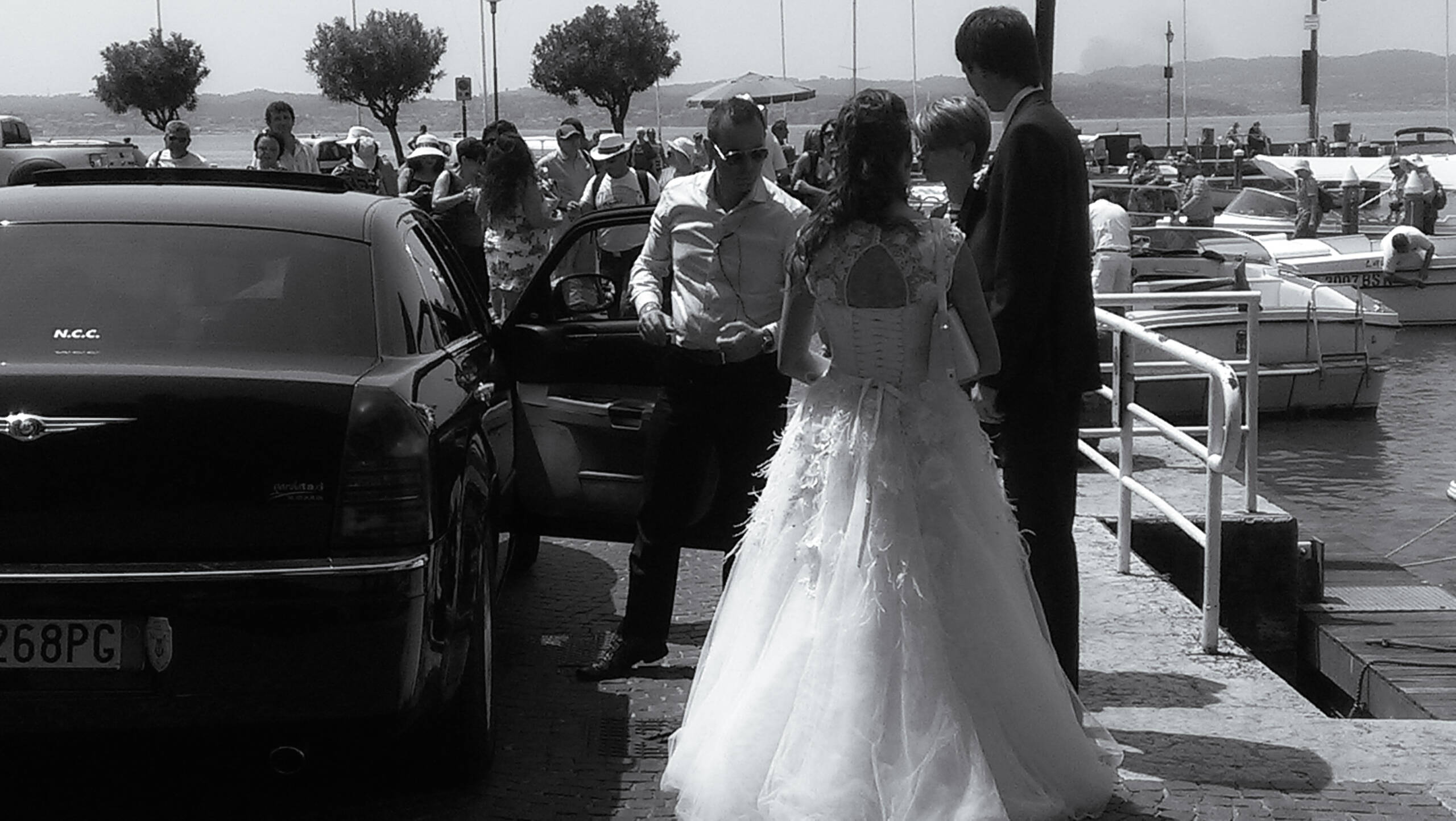
My own frame here is running the same playbook a long way from the Var. Hard sun, backs to the camera, a crowd behind flattened into extras, and only two tones that carry any weight: the black chauffeur-driven saloon on the left, the white dress crossing in front of it. In colour it would be an unremarkable snapshot of a wedding party at a marina. In monochrome the geometry takes over, and the boats and the mooring cleats stop competing.
It isn’t Saint-Tropez. The Perugia plate and the N.C.C. lettering on the boot put it on an Italian lake, and the moment is a private one rather than a starlet arriving for the cameras. The look survives the change of address anyway, because the ingredients were never really about the place. Punishing sun, a crowd, water, someone dressed for an occasion, and a photographer standing far enough back to stay out of it.
The postcard was always incidental. The light was the subject.