Black and White Photographs Built Modern Art History: Malraux and the Museum Without Walls
Almost everything most people know about art, they know from reproductions. Not from standing in front of the object, but from a plate in a book, a slide in a lecture hall, a poster on a wall, a screen. André Malraux gave that condition a name in 1947 and called it the museum without walls: a collection nobody owns, assembled out of photographs, in which a Sumerian seal and a Gothic tympanum and a Florentine marble sit on facing pages as equals.
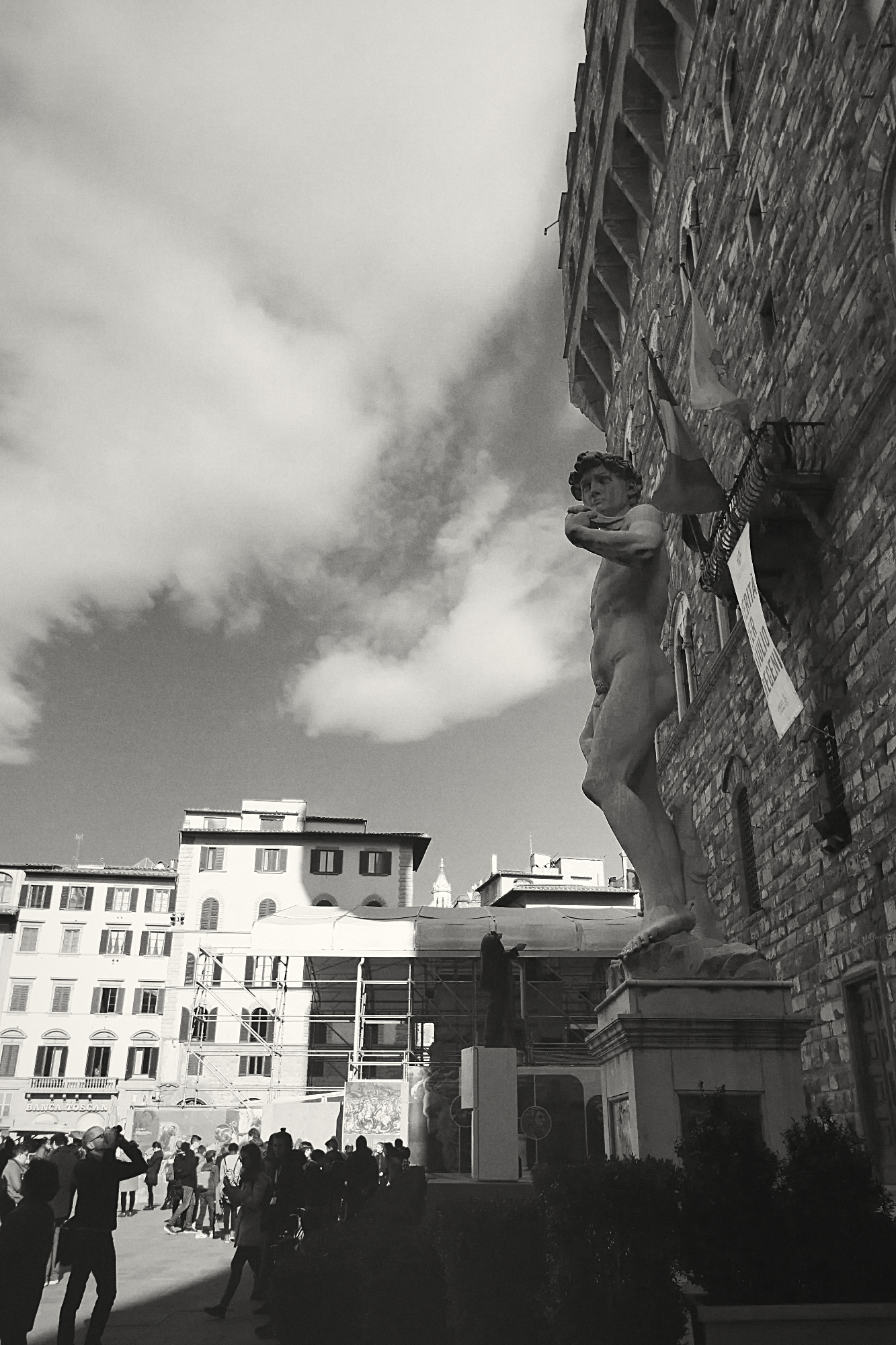
His point wasn’t that this was a shame. It was that it had already happened, that it was the largest change in how art gets seen since the invention of the museum, and that nobody was thinking hard enough about what the camera was quietly deciding on everyone’s behalf.
The Camera Chooses, Then the Choice Becomes the Work
Photograph a sculpture and you have to stand somewhere. There’s no neutral position. Heinrich Wölfflin, teaching in the 1890s, got exercised enough about this to write about how sculpture ought to be photographed, arguing that Renaissance sculptors composed for one privileged viewpoint and that photographers were casually wrecking it by shooting from wherever the light was convenient.
He had a case. A raking side angle turns a calm figure into a dramatic one. A low camera makes a monument out of something modest. Shoot the same marble from the pavement, from a balcony, and from the standard museum three-quarter view, and you get three different sculptures, only one of which the sculptor was arguing for.
Then the plate goes into a book. Students learn from the book. Within a generation, the photograph’s angle is what the work looks like.
Monochrome Was an Argument Nobody Made Out Loud
For roughly a century, art history ran on black and white plates. Colour printing was expensive and unreliable, so the discipline built its habits around images that had thrown colour away.
This favoured some artists enormously and punished others. Sculpture reads beautifully in monochrome, because what monochrome preserves is exactly what sculpture is made of: mass, edge, the behaviour of light on a surface. Drawing survives too. Line survives. What doesn’t survive is the thing Venetian painting was actually doing, or the reason anyone cared about Bonnard.
Generations were taught to value composition and structure over colour, partly for real intellectual reasons and partly because the reproduction technology in the room could only show them one of the two. The bias got baked into the canon before anyone noticed it was a printing constraint.
Scale Disappears Completely
Malraux was sharpest on this. Reproduction flattens everything to the size of a page. An ivory a few centimetres across and a facade forty metres high arrive at the reader identically, and comparisons get made between them that no eye standing in a real room could ever have made.
He thought this produced something genuinely new, which he called a fictitious art: works detached from their site, their scale, their function, their religion, and recombined into a purely visual sequence. Comparative art history is unthinkable without it. So is most of modernism, which spent decades looting African and Oceanic objects through exactly this channel, as plates in books, stripped of everything except form.
The gain is real. Nobody in 1500 could have compared Cycladic figures with Brancusi. The loss is real too, and it’s the part that gets skipped: the object’s size, the angle it wants, the light it was cut for, the wall it faced.
Which Is Why the Angle Matters
A photograph taken from the pavement, looking up, under moving daylight, with the crowd and the building and the flags still in the frame, is doing something a catalogue plate can’t. It isn’t better. It’s making a different claim, and it’s making it visibly, which is the honest version.
The catalogue plate makes claims too. It just hides them behind a grey backdrop and calls it documentation.
Every reproduction is an argument. Most of them pretend not to be.