The Prague Orloj's Calendar Dial Is a Copy of a Copy, and the Last One Changed the Faces
The lower dial of the Prague astronomical clock, lit up at night behind its bird netting. Twelve painted medallions of the months around the rim, twelve smaller zodiac roundels inside them, and the old town’s coat of arms sitting black and gold in the middle. An archangel with a sword on the left. A chronicler with an open book on the right. It looks like the most medieval object in central Europe.
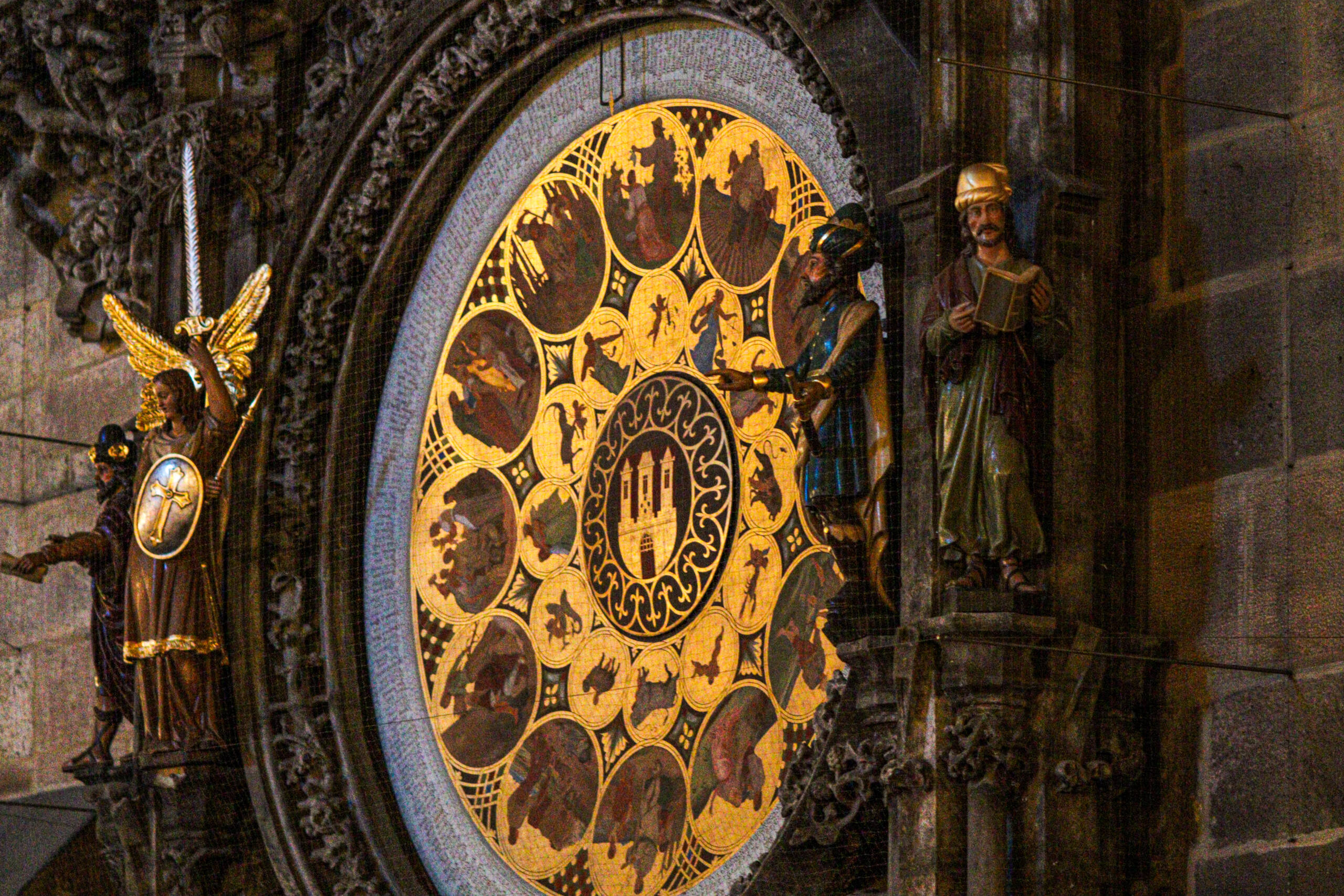
Almost none of what you are looking at is medieval, and the part that carries the most meaning is younger than photography.
The clock mechanism dates from 1410 and the calendar dial was added to the tower around 1490. But the painted disc is from 1865 and 1866, made during a huge restoration by Josef Mánes, the leading Czech painter of his generation, working from a scheme drawn up by the poet Karel Jaromír Erben, then the city archivist. The months show Bohemian country labour. Ploughing, mowing, harvest, pig killing, the year turning over as work rather than as astronomy.
A medieval genre revived for political reasons
Labours of the months is an old form. It runs through cathedral portals and the great illuminated books of hours, where each month gets its peasant and its tool and its zodiac sign above. Mánes knew exactly what he was quoting.
What he was doing with it is the interesting part. This is 1866, deep into the Czech National Revival, on the wall of the town hall of a city where German was the language of administration and Czech was the language of the countryside. Painting the Bohemian agricultural year in the manner of a medieval calendar puts a peasant nation on the front of the building, dressed in the visual authority of the Middle Ages. It is an argument about who the city belongs to, made in tempera and delivered as decoration.
Then they took it down
The paint had a bad time in the weather almost immediately. Within about fifteen years the city removed the Mánes disc for safekeeping and put up a painted copy in its place, with the replacement unveiled in the early 1880s. The original went to the Prague City Museum, where it still is. Mánes had been dead for over a decade by then.
So from 1882 onward, every visitor photographing the calendar of the Orloj has been photographing a reproduction. The clock burned along with the Old Town Hall during the Prague Uprising in May 1945 and came back through another restoration finished in 1948. More copies, more repainting.
The 2018 version and what went wrong
The tower had a full overhaul completed in 2018, and the calendar disc was made afresh by the painter Stanislav Jirčík. It went up, it looked bright and convincing, and for four years nobody checked it against the original in the museum.
When somebody finally did, in 2022, the Club for Old Prague filed a long complaint. Faces had been changed. Ages had been changed. Hairstyles and clothing had been altered, in at least one case the gender of a figure, and a skirt had climbed above the knee. Some of the new faces were said to resemble people the painter knew. Jirčík’s defence was that he had been commissioned to make a technical copy rather than an authentic one, and that he was fixing errors in Mánes. The heritage inspectorate concluded that the painter, the city and the conservators had all failed, and punished nobody. Prague then ordered the disc redone again, with the Academy of Fine Arts taking on the replacement.
What the tourists are photographing
There is a version of this story where the moral is obvious and the copyist is a vandal. It is not quite that simple, because the object was already a chain of substitutions.
A fifteenth-century frame carries a nineteenth-century painting that pretends to be older than it is, replaced by a copy within twenty years, burned in a war, repainted, restored, and copied again by a man who thought he could improve on it. The tourists in the square below are pointing their phones at the newest layer and calling it the oldest thing they have ever seen.
Which is what a monument actually is. Not the original object. The argument about the original object, made visible in paint.