Francis Picabia Painted Machinery in June 1914, Weeks Before the Machines Went to War
The wall label gives the date with unusual precision: Paris, June to July 1914. Francis Picabia was working on a canvas over eight feet tall, filling it with pistons, tubing, gears and flesh, while the Austrian archduke was shot in Sarajevo and the ultimatums began moving between capitals. He finished it, or stopped working on it, at roughly the moment Europe committed itself. Within weeks he was in uniform.
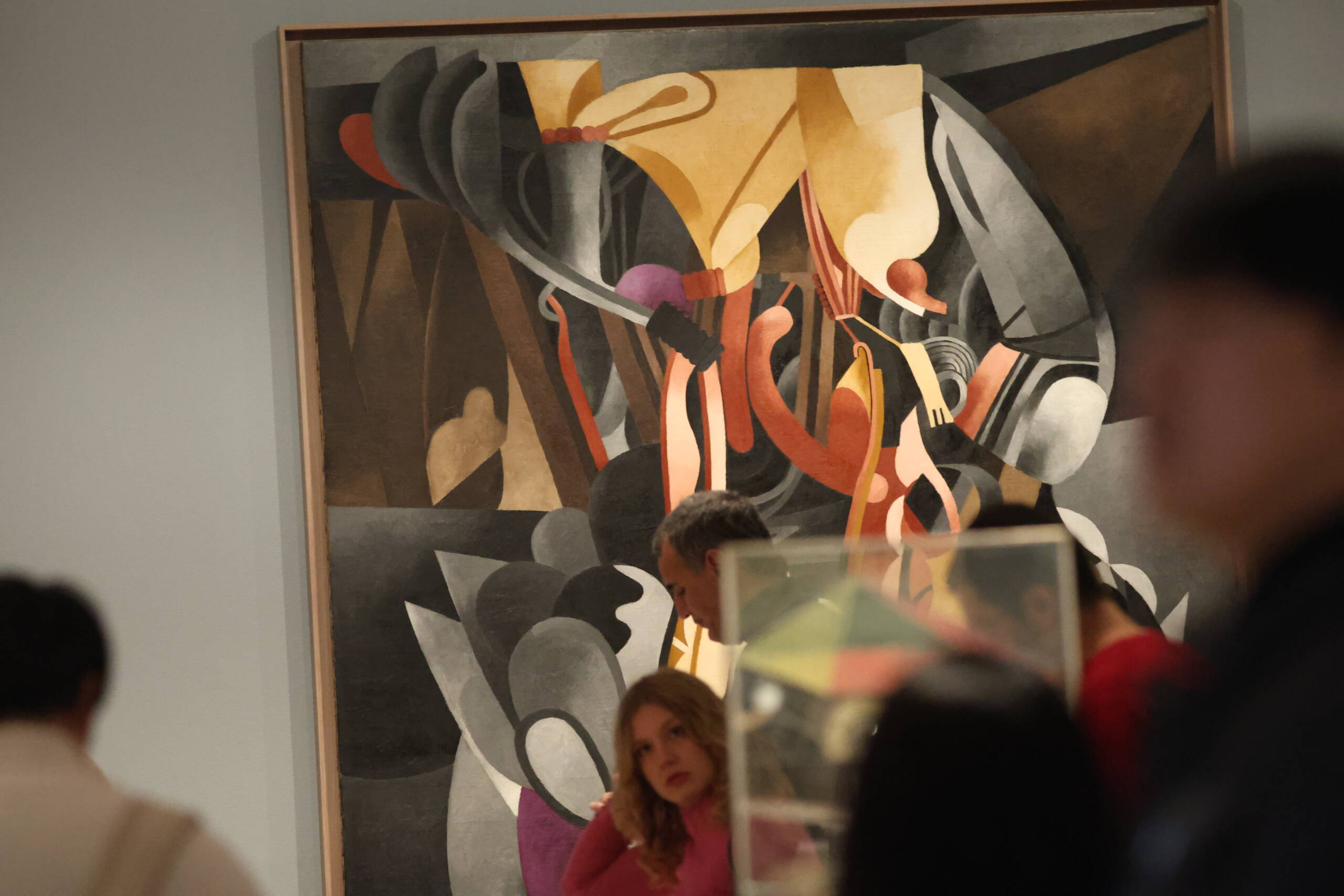
The painting is called I See Again in Memory My Dear Udnie, and it hangs at the Museum of Modern Art in New York. Udnie was a dancer — Stacia Napierkowska, a Polish performer Picabia met on a crossing to New York in 1913, whose act was risqué enough to get her arrested once she arrived. He spent the next two years converting the memory of her movement into monumental canvases that look nothing like a woman and nothing like a machine, but insist on both at once. Grey cylinders slide against salmon-coloured limbs. Something that could be a piston rod terminates in something that could be a thigh. The modelling is soft, almost airbrushed, and it is applied indiscriminately to metal and to skin.
This was the new vocabulary of 1913 and 1914, and Picabia was one of several painters inventing it in parallel.
The Vocabulary Arrived First
Fernand Léger had spent 1913 producing his Contrast of Forms series — cones, tubes and cylinders in collision, colour laid on in blunt slabs, human figures assembled out of plumbing. Marcel Duchamp was working through the chocolate grinder studies that would eventually be embedded in The Large Glass, painting an industrial appliance with the reverence usually reserved for a still life. In London, Wyndham Lewis and the Vorticists were pushing a harder, more angular version of the same instinct, and the first issue of BLAST went out that July with its typographic manifestos and its lists of things to be blessed and cursed. Jacob Epstein had a plaster figure mounted on a real pneumatic drill, an armoured creature straddling the actual machinery it was made of.
None of this was a response to industrial war, because industrial war had not happened yet. It was a response to the factory, the automobile, the ocean liner, the electrified city. Picabia’s 1913 visit to New York had left him with an appetite for American machinery that he never entirely lost. The mood across all of it was appetite rather than dread. The machine was the century’s most interesting new object, and painters were doing what painters do with an interesting new object.
Filippo Marinetti had already taken the argument to its logical end, five years earlier, when he wrote that war was the world’s only hygiene. The Futurists meant it. They wanted the speed, the noise and the violence, and they wanted them in the same package.
Then the Package Arrived
Picabia was mobilised almost immediately and attached to a general as a driver. In 1915 he was dispatched on a procurement mission to Cuba to buy sugar for the army, got as far as New York, and simply stopped. He spent the rest of the war there and in Barcelona, out of range, producing the mechanomorphic drawings that would feed into Dada.
The others had less room to manoeuvre. Léger served as a sapper and was caught in a gas attack at Verdun; he came out of the war painting card players who look like riveted boilers, the same tubular vocabulary now describing men who had been processed by machinery rather than men who resembled it. Henri Gaudier-Brzeska, the Vorticist sculptor, was killed in the trenches at Neuville-Saint-Vaast in June 1915, aged twenty-three. Umberto Boccioni, who had signed the Futurist manifestos calling for exactly this, died in 1916 after a fall from a horse during training. He never made it to the front he had spent a decade advertising.
Epstein performed the most explicit retraction in the history of the movement. He removed his figure from the drill, cut away the legs and one arm, and cast what remained in bronze: a truncated torso, visor down, a smaller shape curled inside the ribcage. The confident operator became a maimed thing with something helpless inside it. The machine that had been the sculpture’s whole point was thrown away.
What Survived
The formal language did not die. The tubes and cylinders, the flattened planes, the interpenetration of body and mechanism — all of it carried straight through the war into Purism, into Constructivism, into the Bauhaus and eventually into the entire visual grammar of twentieth-century design. What died was the innocence of it. After 1918 a painter could still make a picture out of pistons, but could no longer make one that meant only enthusiasm.
Which is what makes the June-to-July date on the MoMA label worth noticing. This canvas sits on the last available margin. The pistons in it are still erotic rather than lethal, still borrowed from a dancer’s body rather than from an artillery piece, and the man who painted them was about to be issued a uniform and a steering wheel. Nothing in the picture knows.
Stand in front of it now, in a crowded gallery, with three phones raised between you and the surface, and it reads as almost cheerful. That is the accurate reading. It was painted by someone who had every reason to be.