The Parakeet Holds Still
There is a moment just before a bird moves when it becomes completely legible. Every feather settles. The eye fixes on something. The body gathers into itself. This painting catches a rose-ringed parakeet in exactly that moment — perched, alert, not yet gone.
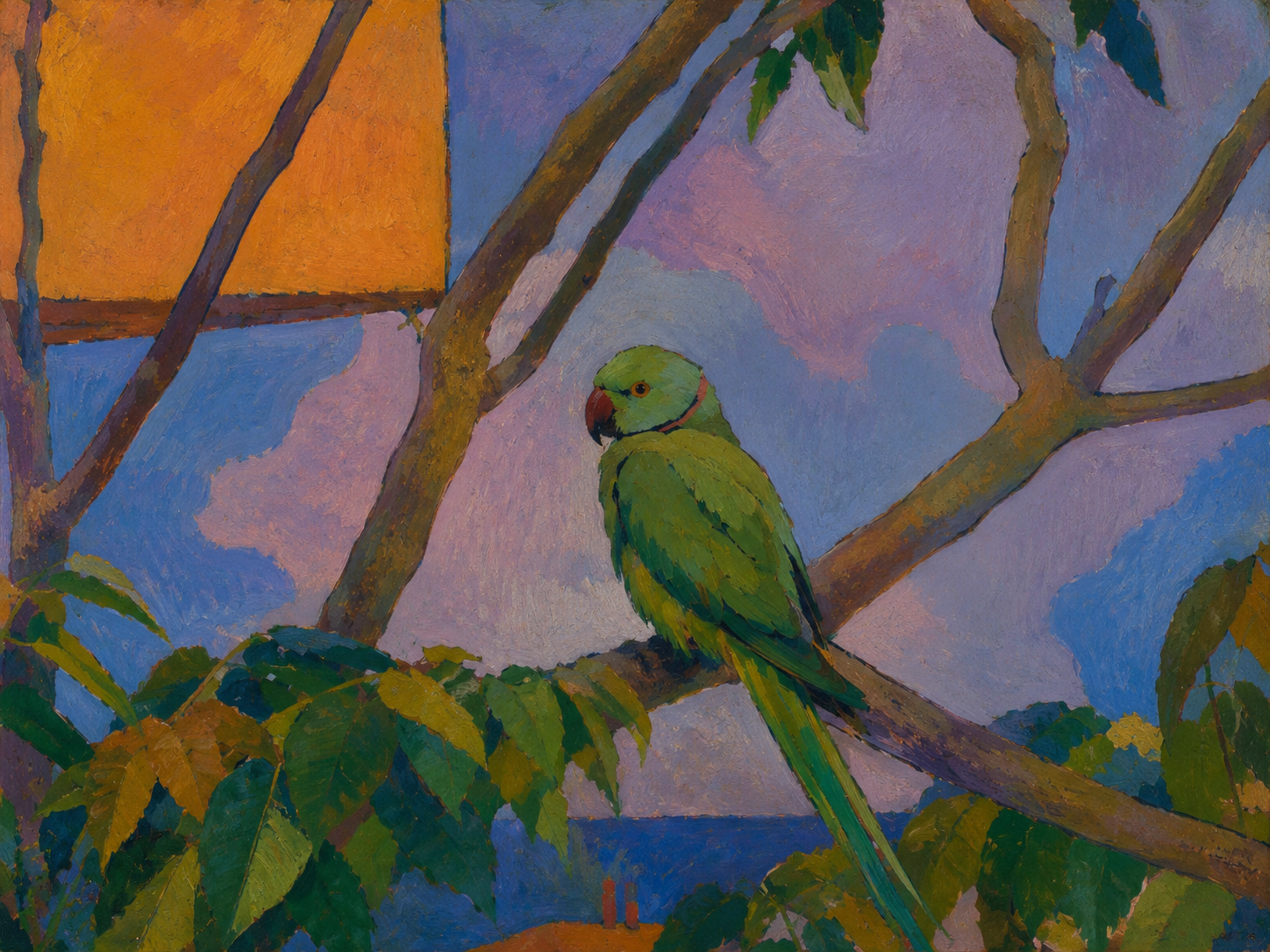
The painter is working in a mode that owes something to Gauguin and something to Matisse but belongs fully to neither. The sky behind the branches is not blue — it is lavender dissolving into pink, the kind of color that belongs to early evening in a warm climate when the light has gone indirect and the air holds heat without source. Against that, the orange rectangle in the upper left reads as architecture: a wall, a shutter, a plane of built color inserted into the natural scene with complete confidence. It does not apologize for being geometric in a composition full of organic curves. It simply sits there and organizes everything around it.
The bird occupies the center without dominating it. The parakeet is rendered in multiple greens — yellow-green at the breast, deeper olive along the back and wings, with the red-and-black bill as the only warm interruption in an otherwise cool-to-neutral body. The tail extends long and pointed, grounding the figure to the branch below. It is a ring-necked parakeet, likely Psittacula krameri, a species that has colonized Mediterranean and Middle Eastern cities so thoroughly that it no longer reads as exotic. It is the urban wild. The painter has placed it anyway against a backdrop that insists on the tropical, on the romantic geography of heat and color.
The foliage is handled loosely at the bottom, broad brushstrokes building leaf shapes without detailing them. The branches are more deliberate — brown, linear, structural — crossing the frame like a natural armature that organizes the lavender sky into sections. At the very bottom edge, a strip of deep blue holds the suggestion of water, sea perhaps, anchoring the palette with the one color that runs cold.
What holds the painting together is the relationship between the orange wall and the green bird. They are across the frame from each other, separated by branches and sky, but they are in conversation. Orange and green at that saturation push against each other without canceling. The bird becomes more vivid because of the wall. The wall becomes more arbitrary because of the bird. Neither would be as interesting alone.
The parakeet is looking at something outside the frame. That, more than anything, is why the image holds.
Sponsored by Pixel Effects.