White Sails on Blue Water
The Mediterranean does not photograph easily. It resists flatness. Every attempt to compress it into a frame — however wide, however carefully exposed — loses something essential: the way light strikes chop at a low angle and scatters, the textural weight of water that has been moving for ten thousand years. Oil paint handles it better than sensors do.
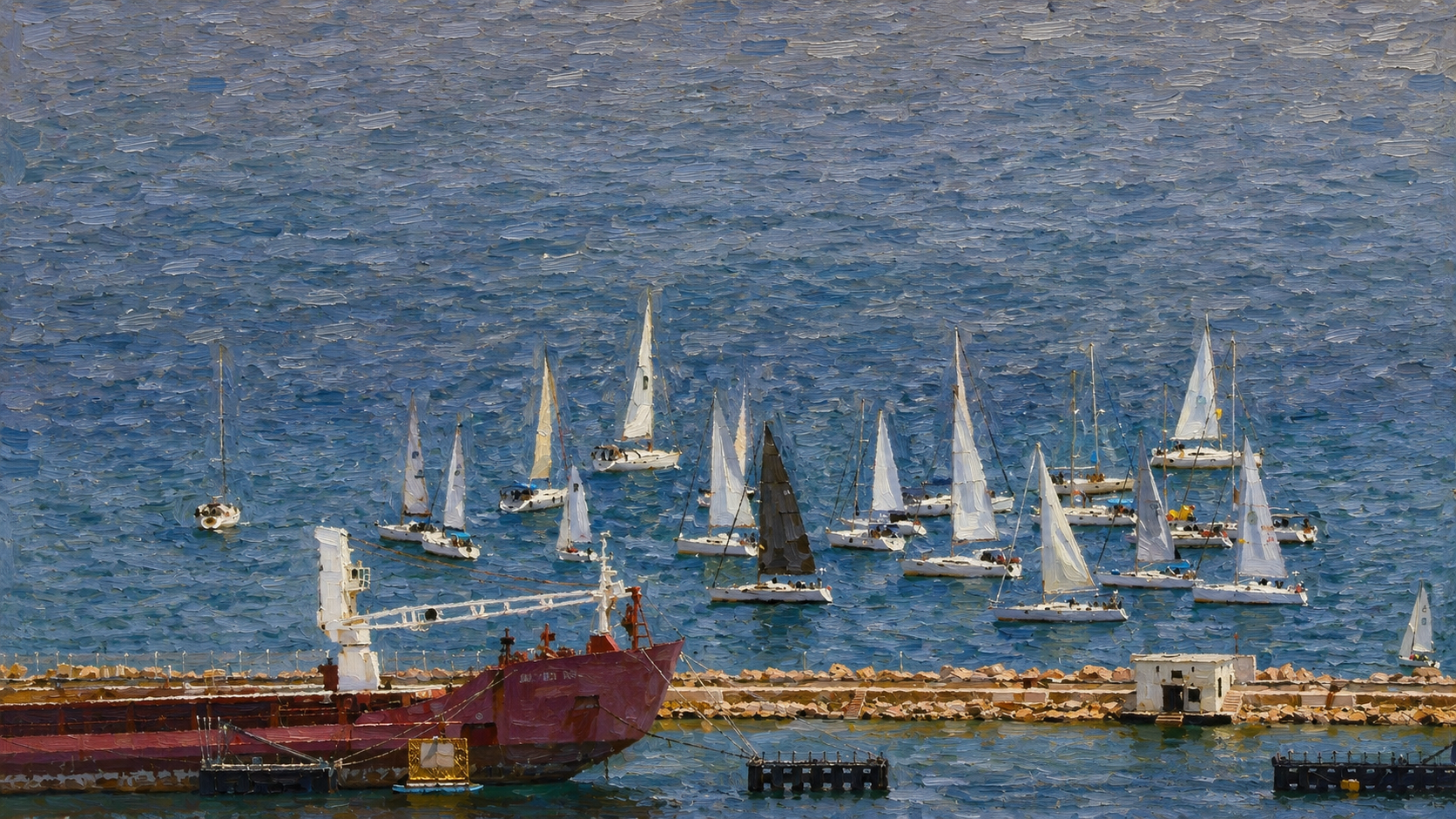
This painting works because it refuses to simplify. The water is not blue — it is twenty blues, applied with a loaded palette knife in short strokes that echo the actual behavior of Mediterranean chop: restless, directional, never quite still. The technique is impasto throughout, every element built up from the surface rather than rendered onto it. Look at the stone breakwater and the bulk carrier’s hull: the same physical insistence, the same refusal to recede into background.
The scene is a regatta — fifteen, perhaps twenty sailboats scattered across the open water beyond the pier. Most carry white canvas. One runs a dark sail, almost charcoal, and that single deviation anchors the composition. Without it, the painting would be merely pretty. With it, there is weight.
The red cargo ship in the foreground is the painting’s real subject, or at least its counterargument. Everything above the breakwater is leisure — weekend racing, clean hulls, the uncomplicated pleasure of wind and tack. The bulk carrier has been working. Its hull is scaled and oxidized, its crane arms folded but ready, its lines running down to cleats that have held real loads. It does not belong to the same world as the sailboats, and the painter knew this. The stone pier is the border between those two economies, and it is rendered with the same thick attention as everything else — nothing in this painting is incidental.
The vantage point is elevated, slightly compressed, somewhere between reportage and memory. A photographer working the same scene would have chosen a longer focal length, isolated the dark sail against the shimmer, or dropped to water level to make the cargo ship loom. The painter chose instead to hold everything in frame simultaneously: commerce and sport, stone and water, the boat going nowhere and the boats going everywhere at once.
That refusal to choose a single subject is what makes it worth looking at twice.
Sponsored by Pixel Effects.