The Met Cloisters Is a 1930s Building Made From Five Medieval Ones
Stand in one of the upper galleries and the room does all the work for you. Tall lancet windows throw cold daylight down a rough plaster wall. The roof is open timber. The floor is brick, worn to a warm red. A carved retable sits on a bracket at exactly the height an altarpiece would have sat, and a tapestry hangs beside it, and the whole arrangement reads as a room that has been standing since the fifteenth century.
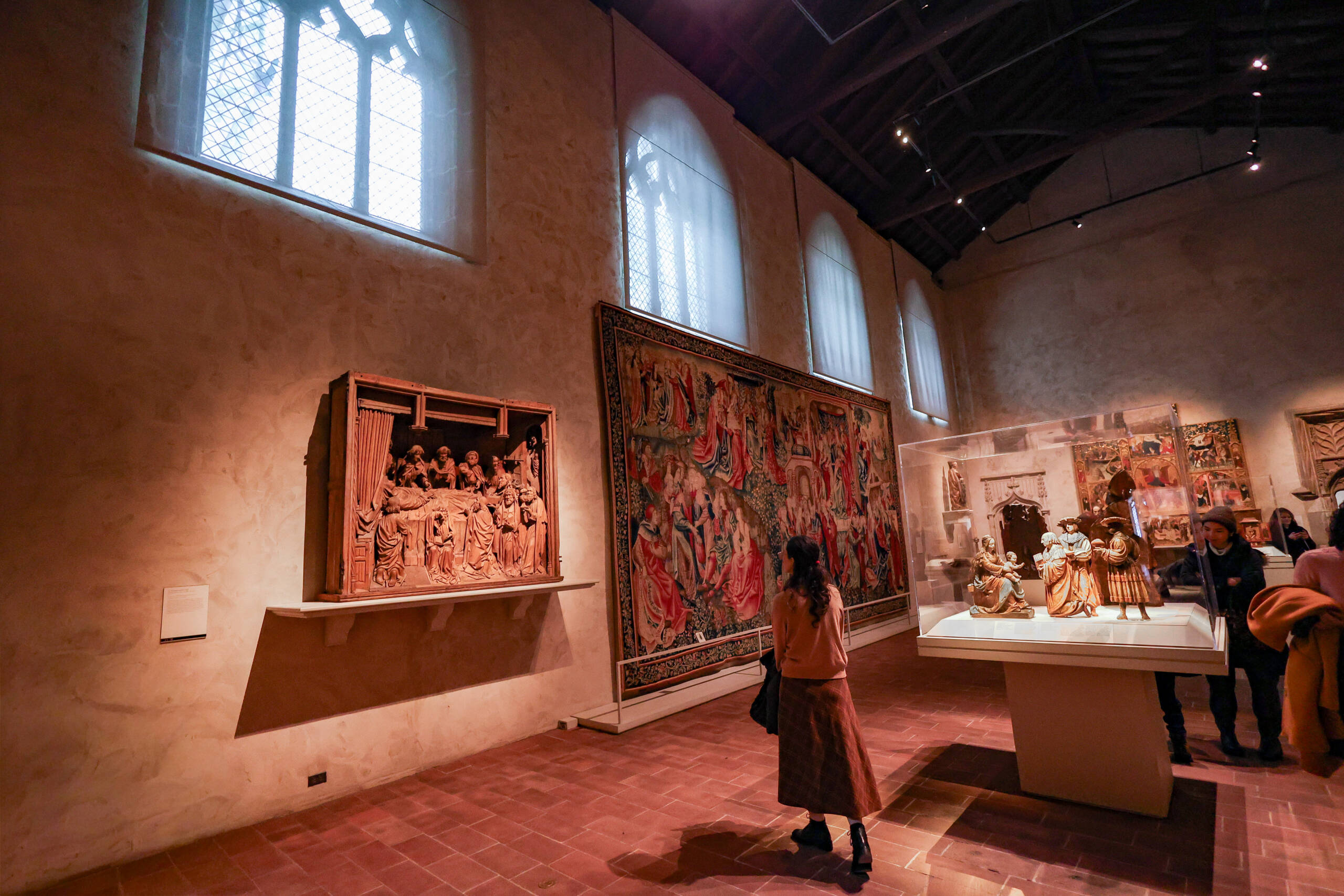
It hasn’t. The building went up in the second half of the 1930s and opened to the public in May 1938, and no part of it ever existed in medieval Europe as a single structure. That is the interesting fact about the Cloisters, and the museum has never hidden it.
The stones are real, the building is not
The collection starts with George Grey Barnard, an American sculptor working in France who spent the years before 1913 buying capitals, columns, arcades and doorways from farmers, dealers and demolition sites across the south. Much of it had been scattered after the Revolution. Monastic arcades ended up as garden walls and pig sheds and cemetery fencing, and Barnard bought what he could find and shipped it to New York, where he opened his own medieval museum on Fort Washington Avenue in 1914.
John D. Rockefeller Jr. bought that collection for the Metropolitan in 1925. He also bought the land in Fort Tryon Park, hired Charles Collens to design a building for it, and then bought the New Jersey Palisades across the Hudson so that nobody could put anything ugly in the view. Construction ran through the second half of the 1930s.
Collens integrated material from five French cloisters into the plan. Saint-Michel-de-Cuxa. Saint-Guilhem-le-Désert. Trie. Froville. Bonnefont, or at least what has long been called Bonnefont. The Met’s own department page now describes the last of these as elements once thought to have come from Bonnefont-en-Comminges, which tells you something about how attribution works with stones bought from a field a century ago. Even the sources are provisional.
Around those five, the building adds a Romanesque chapel from Langon, a chapter house from Pontaut, a twelfth-century apse from Fuentidueña in Segovia, and a great deal of new masonry cut to match. Roughly two thousand objects sit inside, mostly twelfth to fifteenth century.
Why the invention works anyway
The obvious criticism is that this is a stage set. Fair enough. A room made of real fragments arranged by a modern architect is a modern room, and calling it medieval flatters everyone involved.
But look at what the arrangement actually teaches. A carved retable at altar height, lit mostly from a high window, seen from below, at the distance a congregation would have stood. That is information you cannot get from a photograph in a book or from the same object bolted to a white wall under even gallery light. Medieval objects were made for particular light, particular sightlines, particular sequences of rooms. Strip the setting and you keep the carving and lose the argument the carving was making.
Three of the cloister gardens are planted from medieval herbals and estate documents rather than from excavation, which is the same principle applied to horticulture. The plants are evidence-based guesses. They still tell you more about a monastic garden than an empty courtyard would.
What it quietly gets wrong
The seamlessness is the lie. Collens made everything agree. One palette, one register of surface, one calm.
Real medieval interiors were nothing like calm. They were painted, often garishly by our standards, in reds and blues and gold. The stone was not left bare and honest. Buildings were patched across four centuries by masons who did not care about stylistic coherence, so an arcade would sit next to something newer and cruder and nobody minded. They were also full of noise, smoke, damp, and people doing jobs.
The Cloisters gives you the silence and the beautiful raking light. It does not give you the paint or the mess, and a visitor who has never been told otherwise will walk out with a picture of the Middle Ages that is largely a 1930s American picture: monastic, contemplative, tasteful, quiet.
The honest version
Read the building as what it is and it gets better rather than worse. It is a work of curatorial argument from the 1930s, built by a New York architect with Rockefeller money, using genuine stones recovered from the wreckage of French monasticism, to make a case about how medieval art should be seen.
That case has held up for nearly ninety years, which is longer than most museum installations survive.
The stones are older than the argument. The argument is worth knowing about too.