Photographing the Cortile Nuovo at Palazzo Bo, Padua: Flat Light Is the Right Light for White Stone
The Cortile Nuovo at Palazzo Bo is a hard courtyard to photograph and an easy one to walk straight past. Most visitors to the University of Padua cross it on the way to the anatomical theatre and never look up. Look up and you get a travertine frieze of students going off to war, two lines of Latin cut into the wall beneath it, four big round arches, and a row of parked cars sitting under all of it.
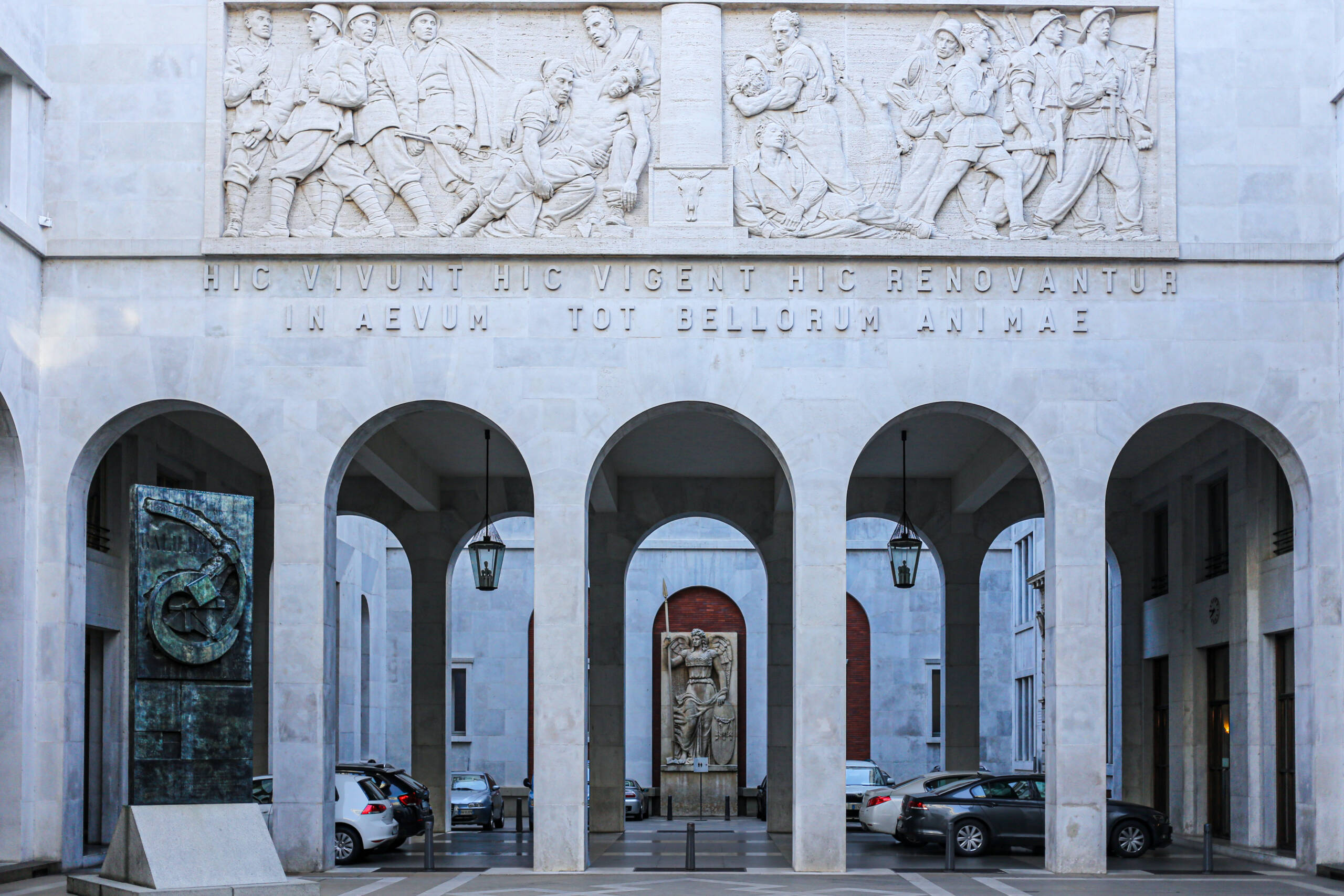
The cars are part of the picture whether you want them or not. There is no angle in that courtyard where they disappear. So I stopped fighting them and shot the wall square on instead, letting the parked line sit low in the frame where it reads as scale rather than clutter.
What you’re actually looking at
The courtyard dates from 1938 to 1942, designed by the Veronese architect Ettore Fagiuoli under rector Carlo Anti, built in pale Istrian stone from Orsera. Gio Ponti handled the interiors behind these walls. It was originally called the Cortile Littorio, and the name tells you what it was for. Anti wanted a space that celebrated the fighting spirit of Padua’s students, and he got one.
The high relief is by Attilio Selva, carved in travertine in 1939. It runs the full width of the east wall in two panels: volunteers marching left, stretcher parties and the wounded in the middle, more columns moving out to the right. The little pier that splits the two halves carries an ox head. That’s not decoration. Palazzo Bo takes its name from a medieval inn called the Hospitium Bovis, the ox, and the building has been signing itself that way for six hundred years.
Under the frieze, the inscription: HIC VIVUNT HIC VIGENT HIC RENOVANTUR IN AEVUM TOT BELLORUM ANIMAE. Here they live, here they thrive, here they are renewed forever, the souls of so many wars.
Through the centre arch you can see the far end of the portico, where a winged Minerva-Victory by Paolo Boldrin stands with spear and shield against the brick. That’s 1942. And on the left of my frame, the dark bronze slab is Jannis Kounellis, Resistenza e Liberazione, installed in 1995. A courtyard built to glorify one war, with a monument to resisting it bolted onto the wall fifty years later, about eight metres apart. Nobody removed either one.
The light problem
White limestone in direct sun is a nightmare. You blow the highlights on the raised parts of the relief and lose the carving entirely, or you expose for the stone and the arches go to black holes. Overcast is the gift here, and this was shot in it.
Flat light does two useful things on carved stone. It keeps the whole tonal range inside about two stops, so the frieze holds detail from the deepest undercut to the brightest edge. And it lets you see into the arcade, which is the difference between a photo of a wall and a photo of a building. Under sun those arches would have been solid shadow and the Minerva at the back would have been gone.
Expose to the right and accept that the histogram will pile up near the top. The stone is genuinely near-white. If your meter drags it to mid grey you’ve lost the point.
Framing a wall you can’t back away from
The courtyard is roughly twenty-something metres across and the frieze sits high. That’s the whole difficulty. You need enough coverage to hold the frieze and the arches together, and you’re shooting up at it from ground level, which means converging verticals unless you correct.
Three things that made this frame work:
Shoot from dead centre. Off-axis in a symmetrical courtyard just looks like a mistake. Find the middle arch, stand on the axis, and use the paving joints to check yourself.
Keep the camera level and crop down afterwards rather than tilting up. Tilting introduces keystone distortion you then have to fix in post, and every correction costs resolution at the edges where the frieze lives. If you have to correct, correct verticals only and leave the horizontals alone.
Put the top of the frame just above the frieze. Cutting tight above it makes the relief feel compressed against the sky. Giving it a strip of plain wall lets it sit.
The two hanging lanterns are the other useful element. They break the repetition of the arches and give the eye somewhere to land in the middle band, which would otherwise be a lot of undifferentiated stone.
What the frame leaves out
The central pier of the courtyard carries a sequence of dates marking the conflicts the students fought in, and one slot was left blank for a victory in the Second World War that never came the way the builders expected. The university ended up with a gold medal for the Resistance instead. My frame doesn’t include the dates. That’s a second photograph, and probably a better one than this.
Go on a grey day. Bring something wide, keep it level, and don’t wait for the cars to move.