The Louvre Pyramid Was Hated in 1984 and Is Now the Museum's Emblem
Draw the Louvre from memory. You will draw a triangle. Not the Cour Carrée, not the Grande Galerie, not the Renaissance wings that took four centuries and a dozen kings to assemble. A triangle with some lines through it, and if you are feeling thorough, a horizontal band of masonry behind it.
That is a strange outcome for a building finished in 1989 against the loudest architectural opposition in modern French history.
What 1984 actually sounded like
Pei was commissioned in 1983 by Mitterrand as part of the Grand Louvre scheme, and the design went public in early 1984. The reaction was not mixed. The heritage commission that reviewed it treated the presentation as an ambush. The press ran the word Disneyland more than once. There were petitions, a preservation association formed specifically to stop it, and a steady undertone about a Chinese-American architect being handed the most French building in France without a competition.
The famous defusing move was theatrical. In 1985 a full-scale outline of the pyramid was staged in the courtyard using cables, so Parisians could stand where it would stand and see what it would block. Enough of them concluded it blocked nothing. Opposition did not vanish, but it stopped being unanimous, which was all the project needed.
The other thing that survived from that period is the 666 story. The pyramid is supposed to contain 666 panes of glass, placed there by a president with an interest in the occult. It contains 673: 603 rhombi and 70 triangles. The myth has outlived every serious criticism made of the building, which tells you something about which kinds of argument stick to architecture.
Why the shape won
The pyramid is 21.6 metres tall on a 34 metre base, with faces raked at 51.52 degrees, close enough to Giza to read as a quotation. Those numbers matter less than what they produce, which is a form with no ornament, no facade hierarchy, no entrance to locate, and no correct viewing angle. It looks the same from all four sides. It has one silhouette.
Compare that with the palace behind it. The Second Empire wings are magnificent and completely unreproducible at small scale. Pavilions, pediments, paired columns, eighty-odd statues in their niches, a roofline that changes every forty metres. Shrink that to a favicon and you get grey mush. Shrink the pyramid and you still have the pyramid.
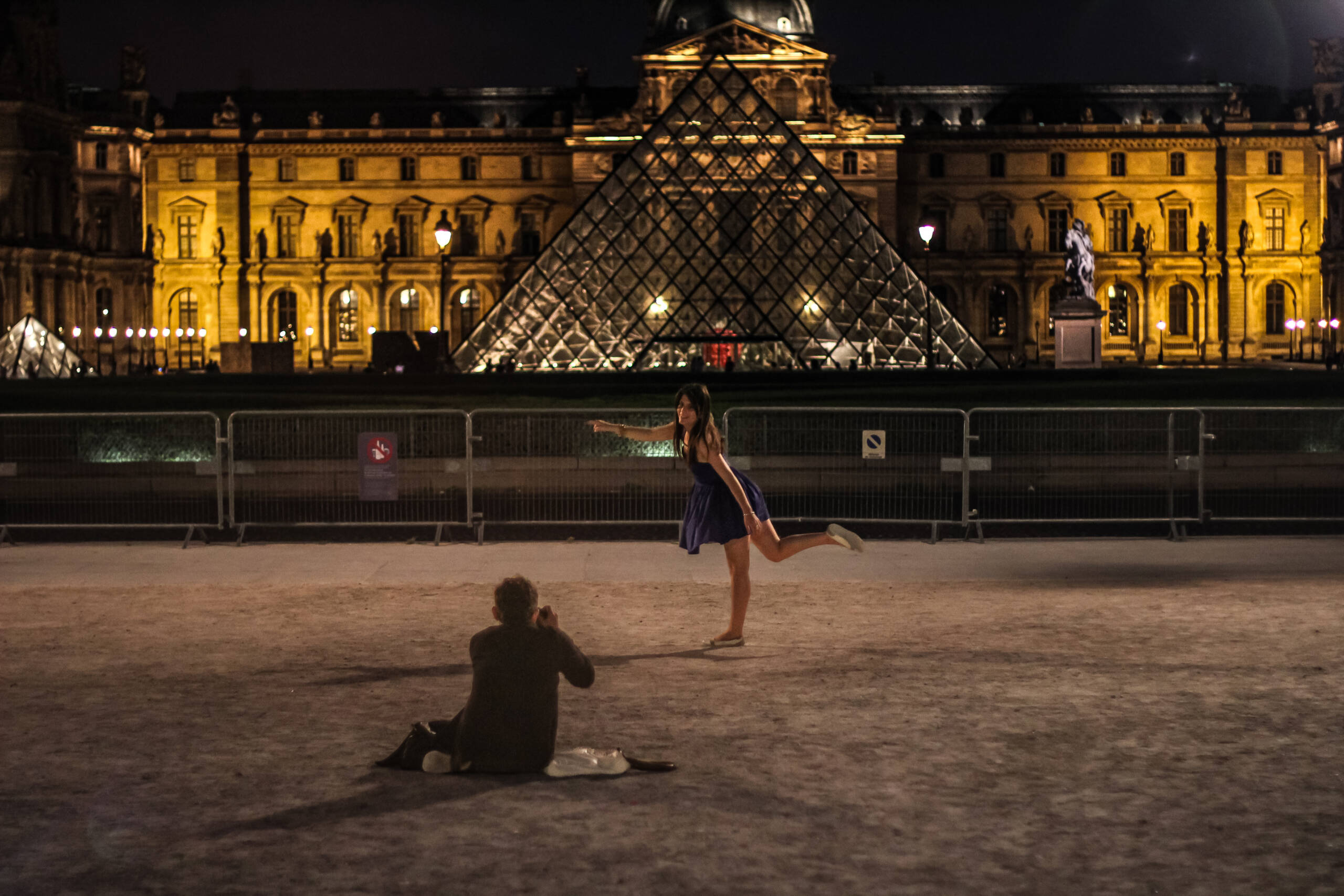
Transparency does the rest. Because the glass reads as line rather than mass, the structure draws itself. The lattice is already a diagram. Photograph it at night, when the palace is floodlit amber and the glass carries the interior light, and the frame does the work a designer would otherwise have to do by hand.
The souvenir test
A building becomes an emblem when it survives being drawn badly. That is close to the whole test. It has to work as a fridge magnet, a stamp, a pictogram on a metro sign, a tattoo, an emoji, a stock vector sold in packs of two hundred. Every one of those uses strips away material, colour, scale, context, and craft. What is left has to still say the name of the place.
The Eiffel Tower passes. The Sydney Opera House passes. Bilbao does not, which is why the Guggenheim there is famous without being drawable. The Louvre palace on its own does not pass either, and it never did, which is the quiet fact underneath this whole story. Before 1989 the museum’s shorthand was a painting rather than a building. The pyramid gave the institution its first symbol that was actually about the institution.
Hostility helped. It always does. The 1887 protest letter against the Eiffel Tower, signed by a good portion of literary Paris, is now printed on merchandise sold at the tower. Controversy generates images, images generate familiarity, familiarity is indistinguishable from affection after about fifteen years. The building that nobody argued about is the building nobody photographs.
The part that undercuts the souvenir
Here is the joke at the end. The most reproduced shape in Paris is one of the least freely reproducible.
The palace is out of copyright by several centuries. Pei’s pyramid is not, and the museum holds the rights to it. France’s panorama exception covers private individuals making non-commercial use, so your holiday photo is fine and your Instagram post is fine. A company using a close-up of the pyramid to sell something is in different territory, and image libraries have carried warnings about it for years. Wikimedia has deleted the pictures in bulk. Some of the workarounds online are photographs of the courtyard with a white triangle blanked into the middle, which is an accidental piece of graphic design in its own right.
So the shape that became the museum’s emblem by being infinitely copyable is legally the one thing in the courtyard you cannot copy. The critics of 1984 lost the argument about taste and won a smaller one nobody was making.
They still hated it for the right reason, though. It was never meant to blend in.