Morning Class: A Photograph That Works Like a Frieze
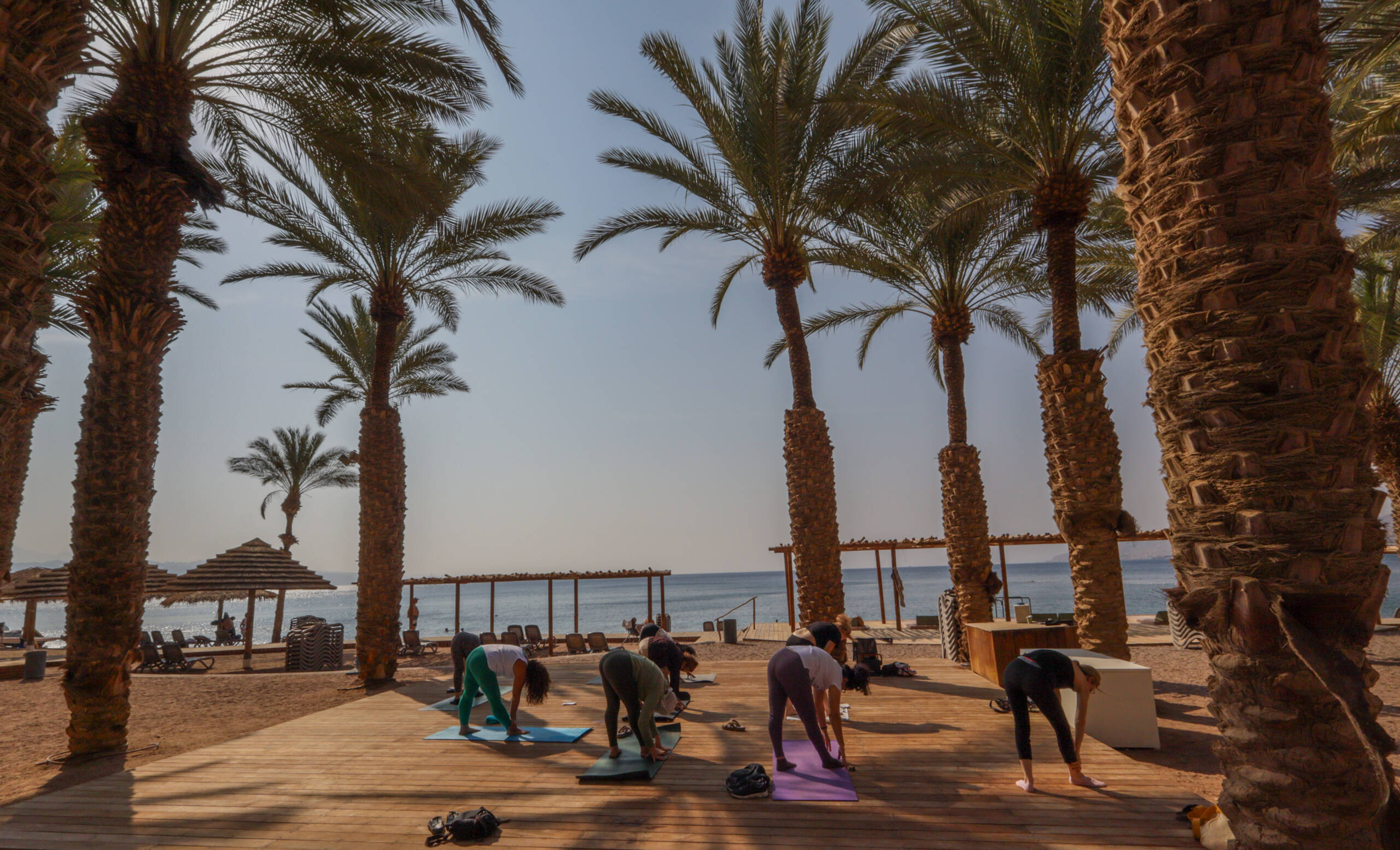
Eight people stand on a wooden deck above a beach, bent forward at the waist with their hands reaching for their mats. Behind them the sand runs to a flat sea and a pergola with birds along its beam. Date palms rise through the whole frame, three on the left, four on the right, one heavy trunk cropped at the right edge. The trunks cut the picture into bays, and the bodies fall inside them.
The object
The frame divides twice. Horizontally it is three bands: pale sky across the top half, a thin strip of sea and sand, then the deck in warm gold across the bottom. Vertically the palm trunks break it into intervals of uneven width, the way a colonnade does. Nothing in the picture is centred. The figures sit low and slightly right of middle, small against the architecture of the trees.
The light comes from behind and low. It flattens the sea to paper, hazes the far shore into nothing, and puts the deck planks into raking gold that picks out every board seam. The trunks on the right are lit on one side and dark on the other. The people are lit on their backs and calves and dark everywhere else, which is why they read as shapes rather than as individuals.
No face is visible. Every head is down. The device the picture uses is repetition with phase difference: the same movement performed by eight bodies caught at eight different points of it, so the eye reads one action rather than eight people. That is a frieze.
The lineage
The Parthenon frieze solves exactly this problem. A procession of riders and animals, all doing one thing, arranged along a horizontal band at a height where nobody can study any single figure closely. The sculptor varies the phase, a leg lifted here, a head turned there, and the row becomes motion instead of a list. Repetition without variation is wallpaper. Variation without repetition is a crowd scene.
Degas took the bent, turned back and made it a subject on its own. The bathers pastels put a woman face down or face away, working the body into a form, refusing the viewer the transaction of a returned look. The anonymity is not shyness. It is what lets the shape be looked at.
Seurat’s bathers at Asnières lines figures along a horizontal band of water in flat light, backs mostly to us, each one absorbed and none of them acknowledging the others. He was solving for how to make separate people into a single composition without inventing a narrative to bind them. So is this picture. The mats do the binding.
What is special about it
The phase difference could not be arranged. Look at the order: one figure is nearly upright, two are halfway down, three are deep in the fold with palms near the boards, one on the far right is folded on bare deck with no mat under her at all. A director would have aligned them. An instructor calling a hold would have aligned them. What is here is the half second where a class is arriving in a position at eight different speeds, and it is the only reason the row reads as movement.
To fake it a photographer would have to pose eight people at eight fixed points of one movement and hope the bodies did not stiffen. They would stiffen. The give in a real fold, the sag of a shirt hem, the hair hanging straight down, the slight sideways lean of the woman in green who has not settled yet, none of that survives instruction.
The second unrepeatable element is the birds. There are twenty or more sitting along the pergola beams, evenly spaced, still. They mirror the row of people below them and nobody put them there.
In the jury pile
At thumbnail size this reads as palm trees and sea, which is the danger. A jury sees a hundred tropical beach frames and clears them fast. This one survives the first pass because the trunks give it a structure that nothing else in the stack has, and because the eye finds the small dark row of bodies second rather than first, which buys it a few seconds of attention it would not otherwise get.
What scores: the colonnade framing, the disciplined colour, mats in teal, blue and violet against gold deck and grey sea with nothing else competing. Also the restraint of shooting from behind. Most photographers in that position walk around to the front and take a worse picture.
What a judge flags: the trunk at the right edge is heavy, soft, and eats a fifth of the frame. It is defensible as repoussoir and it will still be called a mistake by at least one panellist. The upper third is empty sky doing very little. And the subject itself carries a whiff of resort brochure that the picture has to keep arguing its way out of.
On the wall
Print large enough that the phase difference is legible from three metres, which means 90 x 55 cm at minimum. Matte cotton rag, no gloss and no lustre. The backlit haze in the middle distance turns to grey mud on a shiny surface, and the deck highlights blow out under gallery lights.
Frame in pale oak, narrow profile, either a deep window mat or none at all. Nothing dark. A black frame will make the trunks read as bars. Hang it low, at 145 cm to centre, because the picture looks down at its subjects and wants the viewer to as well. It pairs with any other repetition picture in a series: a rank of parked scooters, a market stall of identical fish, a row of columns. Put it third in a sequence of five, after something crowded, so the space in it registers.
Wall label: Morning Class, 2026, pigment print on cotton rag, 90 x 55 cm, edition 3 of 7.
The birds never move.