Promenading Couples After Dark: What Night Street Photography Inherited from Caillebotte and the Gaslight Painters
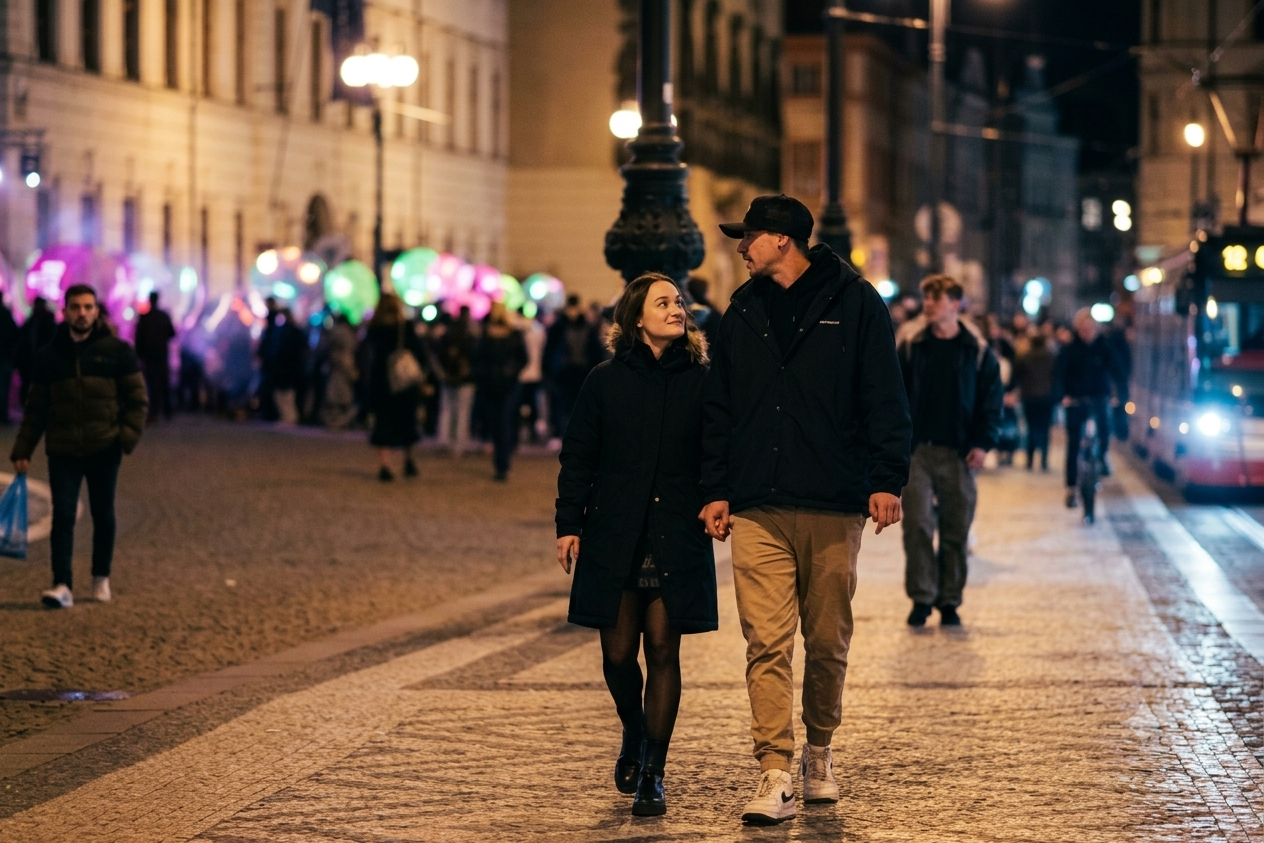
A man and a woman walk toward the camera down a wet cobbled street at night, holding hands, both in dark coats. She is looking at him. He is looking ahead. Behind them the crowd, the tram and the coloured lights of some installation dissolve into a field of soft discs, and the pavement runs away under their feet as a broad grey wedge. It is a photograph, taken in the last few years, and it belongs to a picture type that is three hundred years old.
The couple walking in public is one of the most durable subjects in European art, and it survives because it does a specific job. It puts a private relationship inside a public space and lets the viewer watch the friction between the two. Everything interesting in the picture happens in that gap.
The Form Before the City
Watteau built a career on it. The fête galante pictures, and the Pilgrimage to Cythera above all, are populated by couples in motion: paired figures walking, leaning, turning toward each other while an entire company does the same thing around them. The setting is parkland rather than pavement, but the grammar is already there. Two people are attached to each other and moving through a space occupied by others who are not looking at them.
A century and a half later Seurat does the same thing on an island in the Seine. A Sunday on La Grande Jatte is a park full of leisure, and the figures that anchor the right side of the canvas are a promenading couple, enormous, formal, walking toward the viewer while the rest of the scene arranges itself behind them. The scale relationship is the argument: this pair is the subject, everyone else is the ground.
That is exactly the compositional decision a fast lens makes now, by other means.
Caillebotte Moves It Onto the Pavement
Paris Street, Rainy Day, painted in 1877, is the picture that establishes the modern version. A couple under a shared umbrella occupies the right foreground, close and large. The woman looks slightly across, the man ahead. Around them the wedge-shaped intersection at what is now the Place de Dublin opens up, other figures walk with their own umbrellas, and the wet cobbles hold a grey sheen that Caillebotte renders with obvious pleasure.
The daylight is flat and the mood is not romantic. That is the point of it. Caillebotte is painting the new Paris of Haussmann’s boulevards as a place where strangers move past each other in an organised way, and he uses the couple to show what proximity without contact looks like. The pedestrian entering at the right edge, cropped by the frame, is a device photography would later claim as its own.
Le Pont de l’Europe, from the year before, does the same on a different footing. A man and a woman walk along the iron bridge over the Saint-Lazare tracks. He is a step ahead. She is beside him and slightly behind. Whether they are together is left genuinely open, and the painting is better for not answering it.
Gaslight Was the New Subject
Night pictures of the street had to wait for the street to be lit well enough to have a night life worth painting, and then artists went at it hard.
John Atkinson Grimshaw spent the 1870s and 1880s painting wet gaslit streets in Leeds and Liverpool, with the lamps reflected in the paving and small dark figures walking between them. Boar Lane, Leeds by Lamplight is the type: the surface of the road becomes the light source, doubling every lamp. Any photographer working a wet street at night is making Grimshaw’s picture whether or not they know his name.
Louis Anquetin’s Avenue de Clichy, from 1887, pushes further. The gas light is rendered as flat yellow-green fields with heavy dark contours, figures reduced to silhouettes, and the whole scene bent toward a single artificial colour temperature. Van Gogh saw it and the following year painted Café Terrace at Night in Arles, with its yellow lamplit terrace against a blue sky, refusing to use black.
Béraud worked the boulevards at night as social documentary, with theatre crowds and lit café fronts. Whistler went the other way in the Nocturnes and let the figures dissolve into the dark almost entirely.
Between them they worked out the four things that still govern a night street photograph: light sources sit inside the frame rather than outside it, colour is determined by the lamps, the ground is reflective, and the mass of people reads as tone rather than as individuals.
The Crowd Does Two Different Jobs
Munch’s Evening on Karl Johan, from 1892, is the dark version. A crowd advances down a lit street toward the viewer, faces white and staring, and the effect is of a person surrounded and completely alone. The street is full and the picture is about isolation.
Caillebotte’s couples are the other version. The crowd is present, indifferent, and functions as insulation. Two people are sealed inside it and the anonymity is what lets the private thing happen in public.
The photograph above takes the second position. Thirty people are in the frame. None of them is legible, none is looking, and the couple walk through the middle of it as though nobody else were there. The blur is doing what Caillebotte’s careful spatial recession did: it separates the pair from the population without removing the population.
Photography Takes the Motif and Adds Its Own Claim
Brassaï’s Paris de Nuit in 1933 formalised the transfer. Wet cobbles, fog around the lamps, couples in cafés and doorways, all of it made possible by plates fast enough to work after dark. Ed van der Elsken’s Love on the Left Bank pushed it into narrative in 1956.
Then there is the Doisneau problem. Le baiser de l’hôtel de ville, from 1950, is the most reproduced picture of a couple in a Paris street ever made, and it was set up with hired models. Its later exposure as a staged image damaged it permanently in a way that would mean nothing at all if it were a painting. Nobody asks whether Caillebotte’s couple posed.
That tells you what photography added to the motif. Painting offers a composed truth about how people are together. A photograph offers a claim about one specific evening, and the claim is the whole value.
The Thing the Painters Could Not Have
Look at the glance again. She has turned her head toward him and he has not turned his. It lasted maybe half a second and the shutter took a fraction of that.
A painter cannot use this. A painted expression is permanent, so a face turned in unreturned attention becomes a statement about the relationship, held forever, and the picture curdles into narrative. Watteau’s and Caillebotte’s couples are kept deliberately ambiguous because the medium forces a choice between ambiguity and a verdict.
The photograph can hold the moment without holding the verdict. She looked at him at 9:40 on a Saturday. Two seconds later something else was true. The picture does not claim otherwise, and that is precisely what makes it modern.
Three hundred years of paintings of couples walking, and the newest one has the tram in it.