Balthus at the Met: The Mountain and Nude Before a Mirror Share a Wall
Two Balthus canvases hang at right angles in the same room at the Metropolitan Museum of Art, and the pairing is quietly strange. One is a twelve-foot alpine panorama full of people. The other is a single figure in an airless bedroom. Eighteen years and an entire temperament separate them.
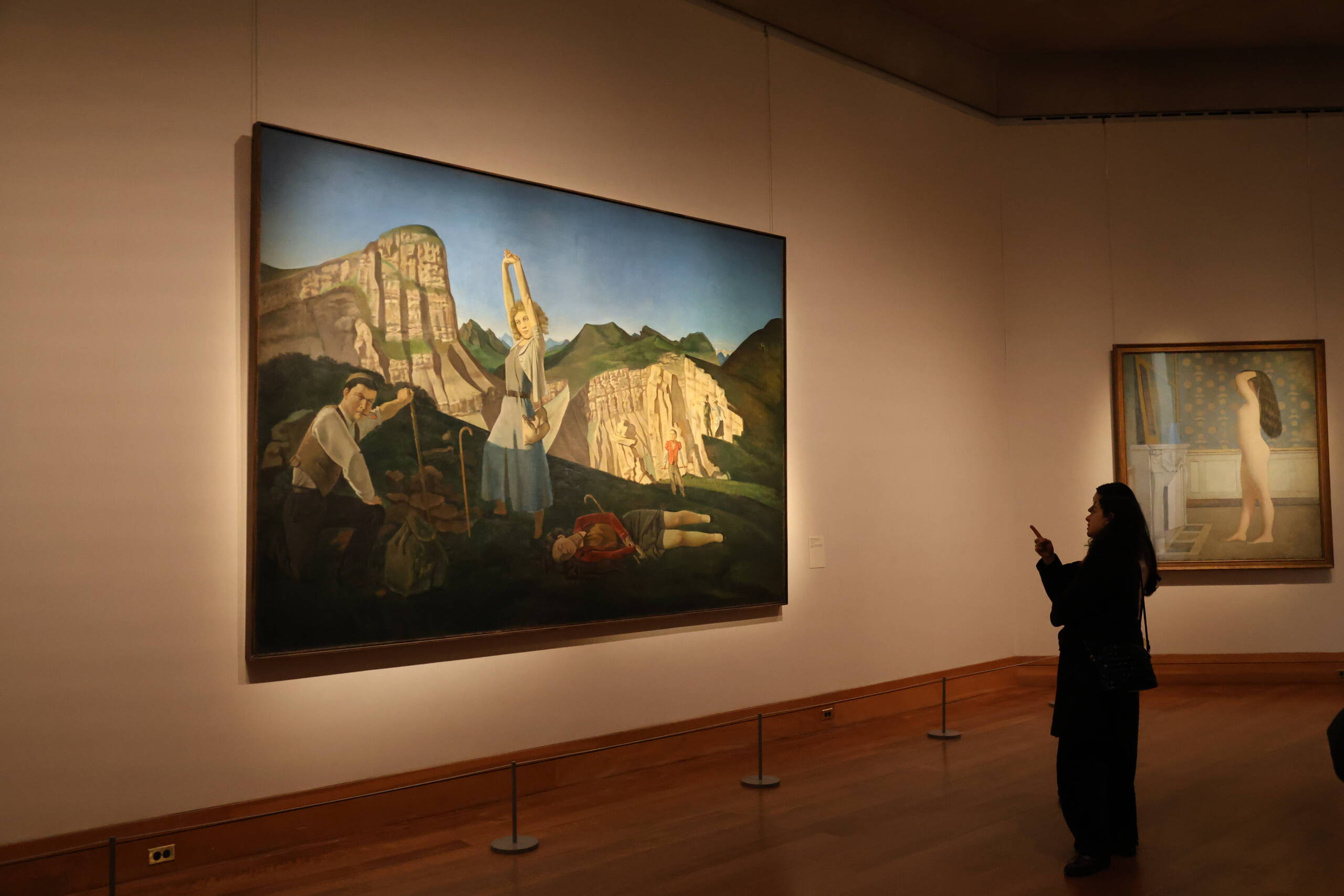
The big one is The Mountain, finished in 1937, oil on canvas, about 249 by 366 centimetres. It was the largest thing Balthus had painted to that point, and he did it in a cramped Paris studio from memory. The setting is the Niederhorn, above Beatenberg in the Bernese Oberland, where he had spent summers as a teenager. He put seven hikers into it. A woman stretches her arms over her head in a gesture that could be a yawn or a signal. A guide crouches over a bag with a pipe in his teeth. A sleeper lies flat on the grass in red, boots pointing at the viewer. Two more figures are small dots against the limestone further back.
What makes the picture uncomfortable is that none of these people are having the same afternoon. They occupy one landscape and seven separate weathers. Balthus meant the canvas as Summer, the opening panel of a four-part cycle of the seasons he never went on to finish, and the borrowings are deliberate. The stretching woman comes out of Courbet’s Young Ladies of the Village. The sprawled sleeper is a nod to Poussin. The pipe-smoking guide was a real person, Fritz Grossniklaus, a friend from his Swiss years. The painting also sits on top of his long pursuit of Antoinette de Watteville, whom he married the year he finished it.
Then you turn ninety degrees and get Nude Before a Mirror, 1955, also known as Nude in Front of a Mantel. About 190 by 164 centimetres, from the Robert Lehman bequest. A young woman stands in profile against patterned wallpaper, hair down her back, facing a mirror propped on the mantelpiece. Everything the mountain picture has, this one refuses. No distance, no weather, no companions, no anecdote. The light is grey and even. The body is handled like carved stone rather than skin, which is the effect people usually reach for first when they describe it.
The wall behind her is worth standing in front of for a minute. Balthus spent years trying to mix what he called Pieran blue, after the wall colour in Piero della Francesca’s frescoes. He was never a modernist in the Paris sense. He was a fifteenth-century painter who happened to be alive in the twentieth, and he said as much, at length, to anyone who asked.
None of this settles the other question that follows Balthus around. The Met keeps Thérèse Dreaming on view and had to defend that decision publicly in 2017 when a petition asked for its removal or recontextualisation. The museum declined. Whatever you conclude about the late work and the girls who sit for it, these two canvases are where the argument gets hardest, because the craft is not in doubt and the discomfort is not accidental. Balthus built it in on purpose and then spent fifty years insisting his pictures should be looked at, not read.
The room does not tell you any of that. It gives you a mountain, a bedroom, a rope barrier and a wooden floor. The rest you bring yourself.