Before Food Photography There Was the Butcher's Shop Painting
Open any restaurant’s feed and the meat looks the same. Shot from directly above, on slate or bare wood, lit evenly, cropped so tightly that nothing else survives in the frame. It is a solved problem, solved the same way every time.
Painters worked on the same subject for four centuries and never once solved it that way. Raw meat has a long and strange career in European art, and the pictures it produced are far more inventive than anything a phone camera does with a rib of beef. They are also, quietly, a manual. The compositional problems are identical. The answers are better.
The Meat Stall That Hid a Sermon
The tradition starts in Antwerp in 1551, with a painting by Pieter Aertsen usually called A Meat Stall with the Holy Family Giving Alms. It is enormous, and the front of it is nothing but food. Sausage links, a pig’s head, a split carcass, tripe, poultry, butter, fish, all shoved forward to the picture plane at a scale that no earlier painting had granted to groceries.
The religious content is banished to the back, small, glimpsed through a gap in the stall. Art historians call this the inverted still life, and it was a genuinely radical piece of picture-making. The viewer is forced to work through abundance to reach meaning, which is either a sermon about gluttony or an excuse to paint meat for its own sake. Aertsen probably wanted both.
His nephew Joachim Beuckelaer made a career of the format, and half of Flemish market painting descends from it. What matters for anyone pointing a camera at a table today is the structural trick. The food is not the subject of the picture. The food is the obstacle placed between the viewer and the subject, which is why it commands so much attention.
Carracci Made It Life-Size
Annibale Carracci painted The Butcher’s Shop in Bologna around 1583, when he was barely twenty. It hangs at Christ Church in Oxford, and the first thing it does is refuse to be a still life at all.
The butchers are life-size. They are working: hanging a carcass, cutting, weighing, dealing with a customer at the left edge. The picture has long been read as containing portraits of people Carracci actually knew, which would make it one of the earliest large paintings to grant ordinary tradesmen the scale and gravity reserved for saints and dukes.
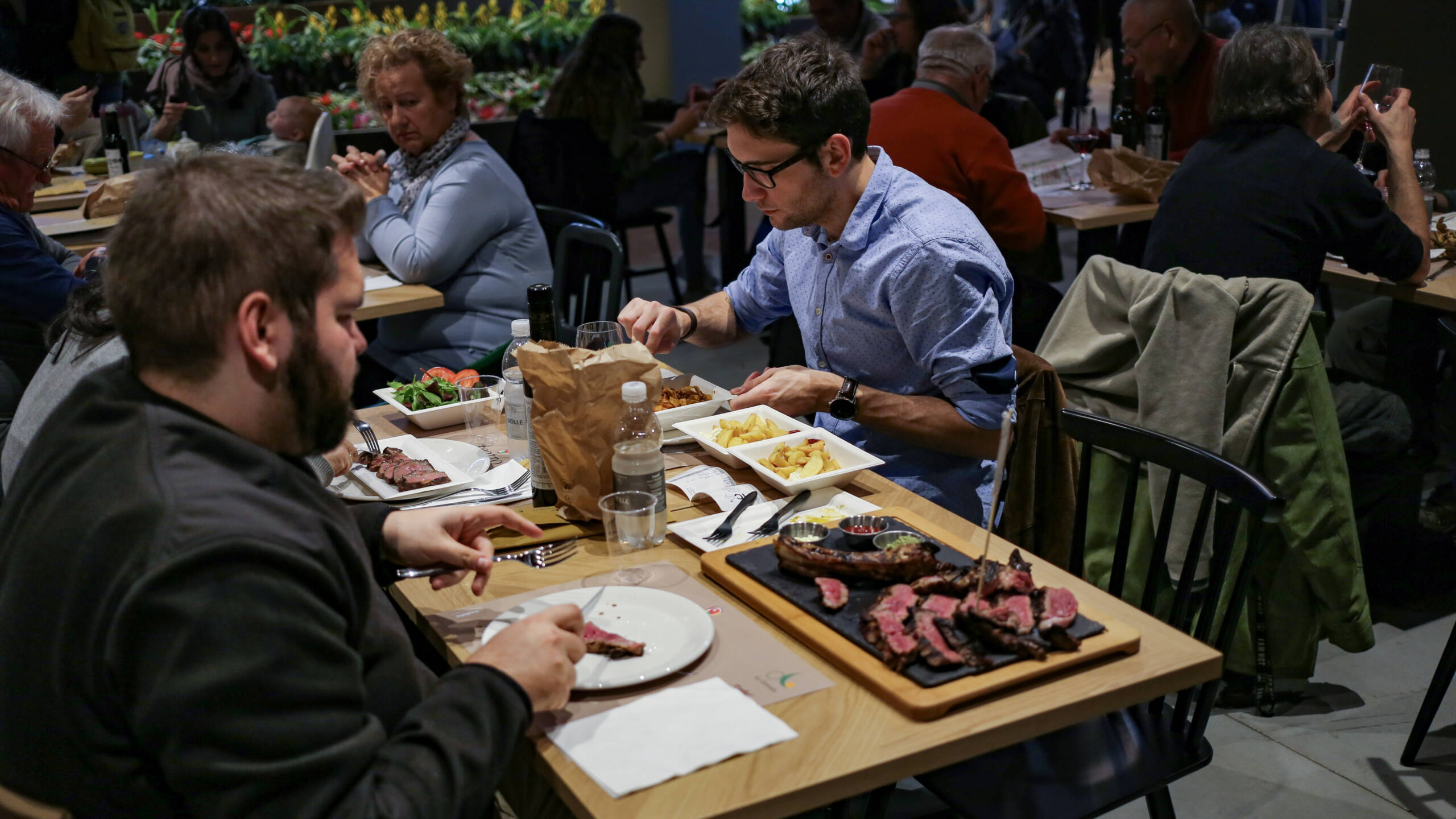
That decision is the whole lesson. Carracci did not isolate the product. He kept the room, the labor, the transaction, and the slightly bored customer, and the meat gained rather than lost by the company. A modern equivalent would be photographing the steak with the receipt, the plastic fork and the crowded room still in the frame, on the theory that the context is what makes the object legible.
Rembrandt Hung It Like an Altarpiece
Rembrandt painted a flayed ox twice, once in the early 1640s and again in 1655. The later version, now in the Louvre, is one of the strangest small paintings of the seventeenth century.
The carcass hangs splayed on a beam in a dark cellar, rib cage open toward the viewer, legs spread in a shape no one can look at for long without thinking of a crucifixion. A woman’s face appears in a doorway behind, barely lit, watching or passing. The paint is thick and worked, built up in ridges of ochre, white and red that behave like fat and muscle rather than depicting them.
Rembrandt did not arrange this. He hung it, and hanging is the point. Vertical, at eye level, lit from one side, against a ground so dark that the flesh is the only source of colour in the picture. The carcass is not a thing on a surface. It is a body in a room, and it has weight.
Soutine Put It in His Studio and the Neighbours Complained
The nineteenth and twentieth centuries kept returning to this. Goya painted a sheep’s head and ribs on a bare slab, an image so blunt it looks a hundred years ahead of itself. Chaim Soutine went further. In the mid-1920s he had a beef carcass brought to his Paris studio and painted it repeatedly, reportedly refreshing it with blood to keep the colour alive as it aged and rotted. The smell brought complaints and, eventually, the authorities.
The paintings that came out of it are almost pure colour. Scarlet, blue, and a violent white, the carcass filling the canvas with no room, no butcher, no context. Francis Bacon took the next step in the 1950s, splitting a carcass and standing a screaming pope in front of it, and after that the subject was more or less exhausted as a metaphor.
What survives from that line is technical. Soutine proved that meat photographs and paints badly under neutral light and beautifully under warm light against cool shadow. Bacon proved that a carcass read as architecture, framed and symmetrical, becomes disturbing in a way a plated steak never is.
What the Camera Can Take From This
Four things, all of them cheap to try.
Light from one side and let the shadow go dark. Even light flattens meat into a texture sample. Raking light gives it a surface, and surface is the only thing that separates a good cut from a red blur.
Keep the room. Carracci and Aertsen both understood that a butcher’s shop is a place before it is a product, and that the people handling the food carry more information than the food does.
Use the vertical. Almost all food photography is horizontal, taken looking down. Rembrandt’s ox works because it hangs, and because the viewer stands at its level rather than above it. A carcass, a hanging bird, a rack, anything suspended breaks the flat-lay habit immediately.
Put something dull next to it. The inverted still life exists because abundance needs a counterweight. Bare board, plain plate, a corner of a receipt, an empty glass. Red against dark and dull is the oldest trick in the genre and it has never once failed.
The butcher’s shop painting was never really about dinner. It was about mortality, labour, appetite and the particular difficulty of painting something wet, and the fact that a phone can now capture the same subject in a fortieth of a second has not made those problems go away.