MoMA's Cubist Salon: Why the Museum Crowded a Wall It Spent Decades Emptying
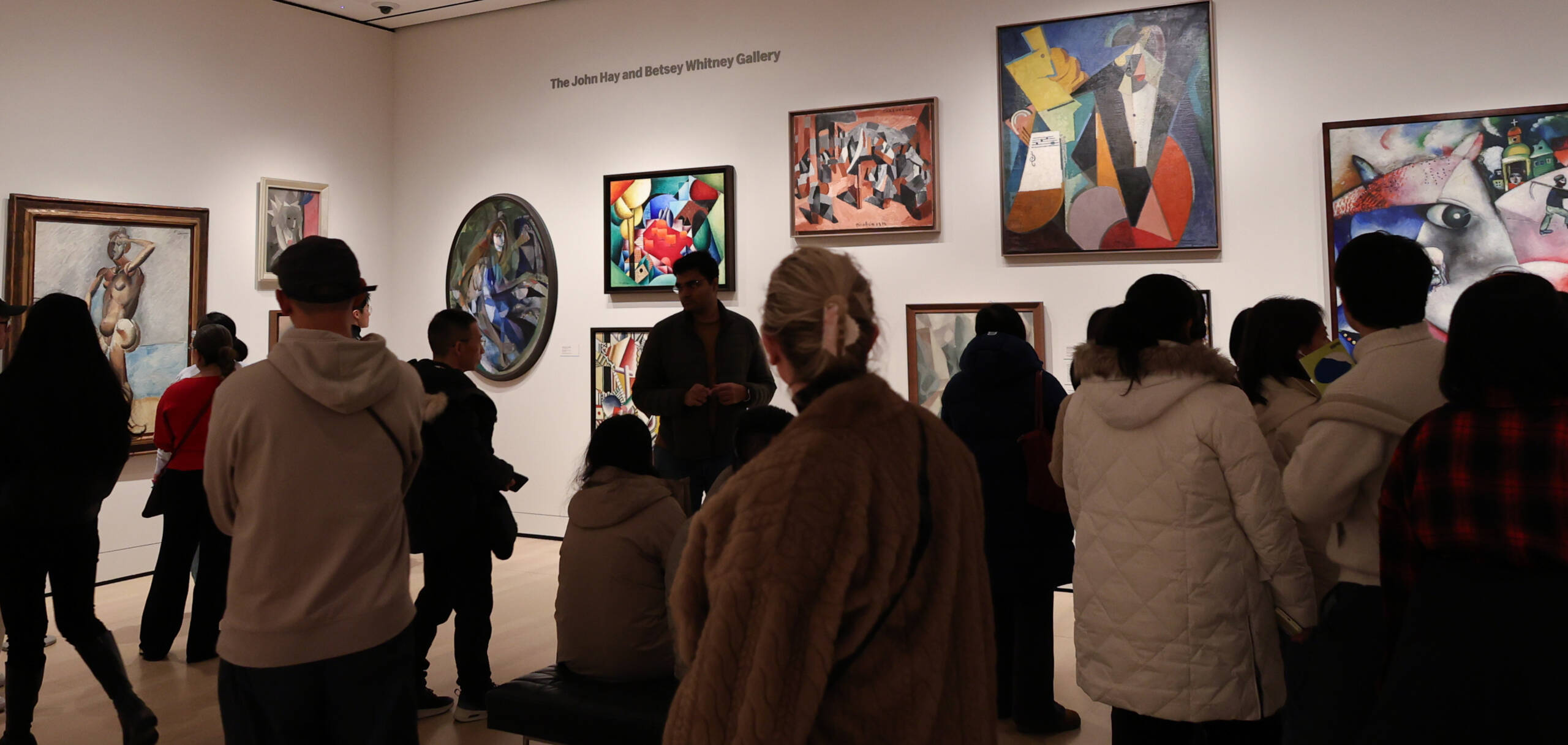
A dozen people in winter coats stand with their backs to the camera while a guide talks. Above and behind them, eleven or twelve paintings crowd a single wall in two and three loose tiers, tondos beside rectangles, wide frames beside narrow ones, a Chagall village floating at the far right with its white horse and its enormous eye. Nobody in the photograph is looking at the same picture, and several of them are looking at the guide instead.
The wall as an argument
This is a deliberate hang, and the density is the point. The room gathers painters conventionally filed under Cubism next to painters filed under everything else that was happening in Paris between roughly 1908 and 1918, and it puts them at close quarters so the differences have to be worked out by eye rather than by label. Chagall does not belong in a Cubist canon. He belongs on this wall, because he was in the same city arguing with the same problems, and the hang refuses to sort him out of the conversation.
The tiering does something specific. When paintings sit at one height in a single line, each becomes an individual object with its own pool of attention, and the viewer moves along the wall like a reader moving along a sentence. Stack them and the wall becomes a field. You take it in whole, badly, before you take in any part of it, and the first impression is of a shared temperature rather than of eleven separate achievements.
Barr’s empty wall, reversed
The single-line hang on a white wall is not a neutral default. It was an argument too, made by this museum, and largely won by it. Alfred Barr’s installations in the 1930s stripped away the crowding and the patterned wall coverings of the nineteenth-century salon and gave each canvas its own quiet rectangle of space. The effect was to declare each work autonomous, self-sufficient, a thing to be judged on its own terms rather than against its neighbours. That premise then spread to every serious museum in the world and to nearly every commercial gallery.
The cost of winning was that the sparse hang stopped reading as an argument at all. It became simply how art is shown, which means the claim it makes about autonomy now passes without examination.
Putting a salon back inside the building that abolished it recovers the argument by staging the alternative. Crowded, the paintings stop being masterpieces and start being evidence. You see how many people were making sharp-angled figures out of brown and grey in the same few years, and how ordinary the radical vocabulary looks when eleven versions of it hang together. That is closer to what a Paris studio visit would have felt like than a single line of anointed objects ever gets.
What the crowd does with it
The visitors in the photograph reveal the trade-off. A dense wall gives you no instruction about where to begin, so a group in front of it turns toward whoever is talking. The guide becomes the hang. He supplies the sequence the wall declines to supply, and the room quietly depends on him to do it.
Nobody is standing close to a canvas. Nobody is reading a label. The bench in the middle holds one person who has stopped looking at the wall altogether. The salon hang asks for more work from the viewer than the single line does, and this crowd, on a cold day, in coats, has outsourced that work to the man in the middle of the room.
Whether that counts as a failure depends on what a gallery is for. If the goal is a private encounter with one painting, the crowding gets in the way and the empty wall wins. If the goal is to show that Cubism was a crowd rather than a canon, the crowding is the only honest way to say it.
The paintings jostle. The visitors listen. Somebody has to decide where to look first.